
Beyond VC: 5 Smart Funding Strategies for Your Startup
For the better part of the last decade, the startup ecosystem has operated under a singular, overpowering dogma: growth at all costs. The headline-grabbing metric of success was rarely profitability or sustainable unit economics, but rather the valuation achieved at the next fundraising round. Founders were encouraged to burn cash to capture market share, with the implicit promise that the next tranche of venture capital would always be there to refill the tank. However, as interest rates have climbed and the macroeconomic tide has turned, that promise has evaporated. The era of free money is over, and in its wake, a new paradigm is emerging—one that prioritizes capital efficiency, sovereignty, and the strategic deployment of alternative financing.
For female entrepreneurs, who historically received less than 3% of venture capital funding even at the market’s peak, this shift is not a catastrophe; it is a validation. Women have long been forced to build businesses with more discipline and less capital than their male counterparts. Now, that necessity is becoming a competitive advantage. The goal is no longer just to raise a massive Series A; it is to build a company that retains its optionality. To do this, savvy founders are looking beyond the traditional VC pitch deck to a diversified stack of funding strategies that preserve equity and demand operational excellence.
1. Strategic Grants: The Hidden Capital
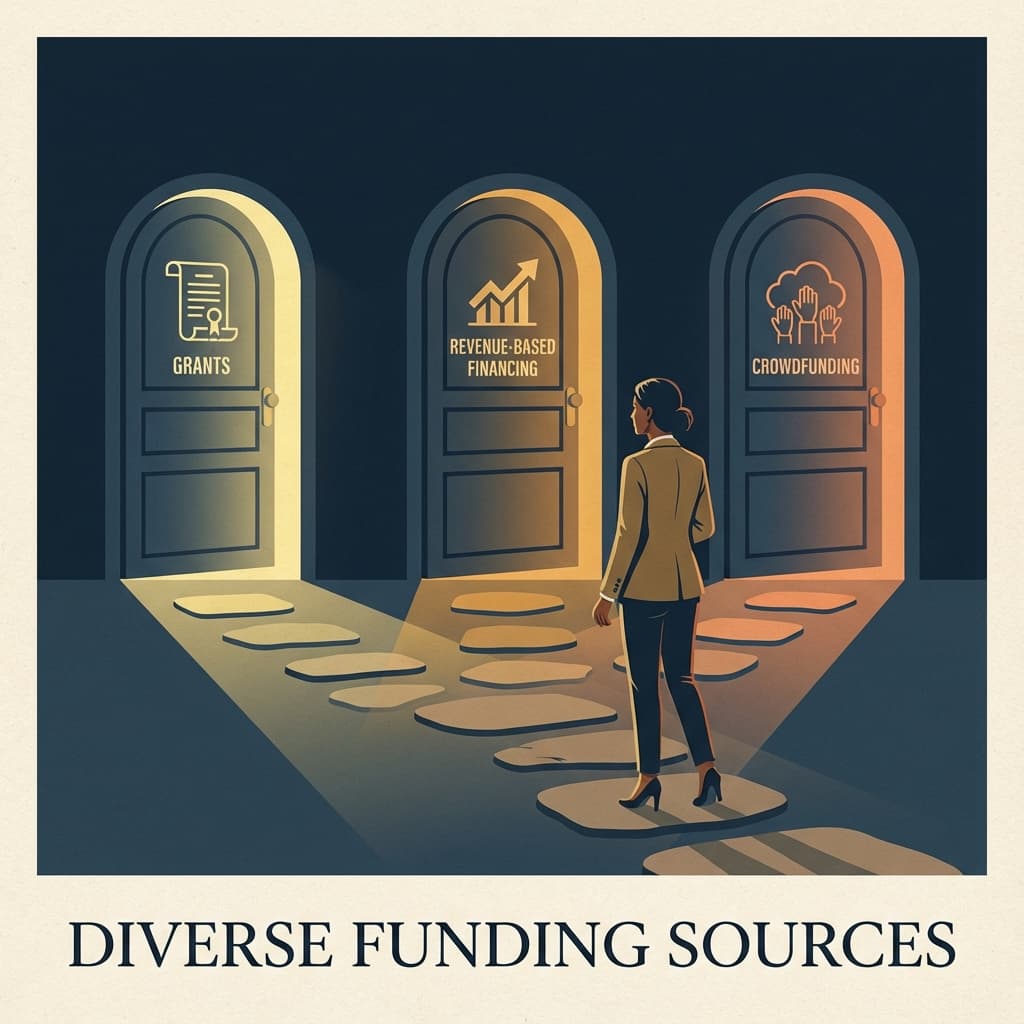
The first layer of this new capital stack involves a reassessment of "free" money. While often overlooked by high-growth tech startups, strategic grants represent a critical source of non-dilutive capital. Unlike a loan that requires repayment or an equity investment that permanently reduces the founder's ownership, grants from government programs or corporate initiatives—such as the Cartier Women's Initiative—act as direct injections of equity-free cash. These are not merely charitable contributions; they are economic development tools designed to de-risk early-stage innovation. For a founder, securing a substantial grant is arguably the most efficient form of financing available, as it extends the runway without impacting the capitalization table, allowing the company to reach higher valuation milestones before eventually seeking outside investors.
2. Revenue-Based Financing
However, grants are finite. A more robust engine for scaling is found in the restructuring of revenue itself. The emergence of Revenue-Based Financing (RBF) has fundamentally altered the landscape for companies with recurring revenue models. In the traditional VC model, a founder sells a permanent piece of the company for a temporary injection of cash. RBF flips this logic. By trading a small percentage of future gross revenues for upfront capital, a founder can fund marketing or inventory without a board seat requirement or a valuation cap. This aligns the capital provider with the company’s actual performance: payment scales up when revenue is high and slows down if the market dips. It is a flexible instrument that respects the founder’s ownership, treating capital as a utility rather than a marriage.
3. Equity Crowdfunding
Simultaneously, the definition of an "investor" is undergoing a democratization process through equity crowdfunding. Platforms compliant with modern regulation have transformed customers from passive consumers into active stakeholders. This goes beyond the rewards-based campaigns of the past; this is about allowing the community to own shares in the business. When a customer becomes a shareholder, their lifetime value (LTV) increases, churn decreases, and they become a vocal brand ambassador. Raising capital from the crowd validates the product-market fit in a way that a check from a single institutional investor never could. It turns the fundraising process into a marketing event, building a defensive moat of loyalty around the brand.
4. Strategic Partnerships
Yet, perhaps the most sophisticated form of capital comes from strategic partnerships with incumbent players. Large corporations are often sitting on significant balance sheets and are desperate for the innovation that agile startups provide. Rather than approaching a VC, a founder might negotiate a deal where a larger partner funds development costs in exchange for a licensing agreement or a "first-look" distribution deal. This is distinct from a corporate venture capital investment; it is commercial funding. It validates the technology, provides immediate distribution channels, and funds the product roadmap, all while keeping the founder in the driver’s seat regarding the company’s ultimate direction.
5. The Service-to-Product Pivot
Finally, there is the resurgence of the service-to-product pivot—a classic bootstrapping technique that is arguably the most reliable path to product-market fit. Many of today’s most successful software companies began as agencies or consultancies. By offering high-margin services, a founder can self-fund the development of a scalable product. This approach requires patience, as the service revenue must support the R&D burn, but the payoff is absolute control. A founder who bootstraps to profitability via services arrives at the negotiation table with investors—if they choose to raise at all—with infinitely more leverage than one with a slide deck and a burn rate.
The narrative of the "unicorn" is being rewritten. We are moving away from celebrating the amount of money raised and toward celebrating the efficiency with which revenue is generated. In this new reality, capital efficiency is not just a survival tactic; it is the ultimate badge of honor. By weaving together grants, revenue-based financing, community equity, and strategic revenue streams, female founders are not just funding their dreams—they are ensuring they still own them when they come true.